Skip to content
If your reflection looks a little more tired, heavy, or softened than you feel, but surgery feels like too much, this guide to PDO thread lifts is a good place to start. Thread lifts sit in a very specific lane of aesthetic medicine – more noticeable than skincare alone, less invasive than a surgical facelift, and highly dependent on technique, anatomy, and patient selection.
Table of Contents
ToggleThat last part matters. PDO threads can create beautiful, natural-looking improvement when the treatment plan fits the face and the goal. They can also disappoint when they are treated like a shortcut for concerns that really need surgery, volume restoration, or skin resurfacing instead.
What a PDO thread lift actually does
A PDO thread lift uses dissolvable polydioxanone threads placed under the skin to create support and a subtle lifting effect. Depending on the type of thread used, treatment may also stimulate collagen over time. In practice, that means threads can help reposition mild sagging, improve facial contours, and refine areas that have started to lose structural definition.
Patients often ask if threads “replace” a facelift. They do not. A surgical facelift addresses deeper tissue laxity and more advanced aging. PDO threads are better thought of as a minimally invasive option for early to moderate looseness, especially when someone wants visible improvement with less downtime and no incisions.
The best results usually come from precise expectations. Threads can lift the cheeks, soften jowling, support the jawline, improve a heavy lower face, and in some cases create a brow lift or improve the look of the neck. They can also be combined with other treatments when lifting alone is not enough.
A practical guide to PDO thread lifts and thread types
Not all threads do the same job. The broad category is PDO, but the thread design changes the result.
Barbed or lifting threads are used to mechanically reposition tissue. These are the threads that create the visible lift people usually mean when they talk about a thread lift. Smooth threads are different. They do not create the same pull, but they can support collagen stimulation and improve skin quality in areas with crepey texture or early laxity.
This is one reason consultations matter so much. A patient may come in asking for a lower face lift, but after an exam, the better plan may be lifting threads in one area, filler in another, and collagen-stimulating treatment elsewhere. The most natural outcomes rarely come from forcing one service to solve every concern.
Who is a good candidate?
The strongest candidates are patients with mild to moderate sagging, fair skin quality, and realistic expectations. Often, that means someone noticing early jowls, softening along the jawline, mild cheek descent, or a heaviness through the brow or neck that was not there a few years ago.
Age alone is not the deciding factor. A healthy patient in their 60s with moderate laxity may be a better candidate than someone in their 30s with very heavy tissue or significant volume loss. The condition of the skin, underlying tissue support, facial anatomy, and treatment goals all matter more than a number.
Threads are usually less ideal for patients with very thin skin in certain areas, advanced sagging, or expectations that are closer to surgical results. They may also not be appropriate for people with certain medical conditions, active skin infections, or healing concerns. A qualified medical provider should review all of that before treatment is scheduled.
What areas can PDO threads treat?
PDO threads are commonly used in the midface, lower face, jawline, brows, and neck. Some patients also ask about a fox eye effect or support around the nasolabial region, but these treatments need careful planning. A trend-driven look is not always the same thing as a balanced, lasting result.
For many patients, the lower face and jawline are the biggest priority. This is where early jowling and loss of definition can make the face look heavier or less rested. In the right candidate, threads can sharpen contour without making the face look overfilled.
The brow is another popular area because a subtle lift can refresh the eyes without changing expression. That said, small changes around the eyes can make a big visual impact, so this is not an area for guesswork or aggressive placement.
What to expect at your appointment
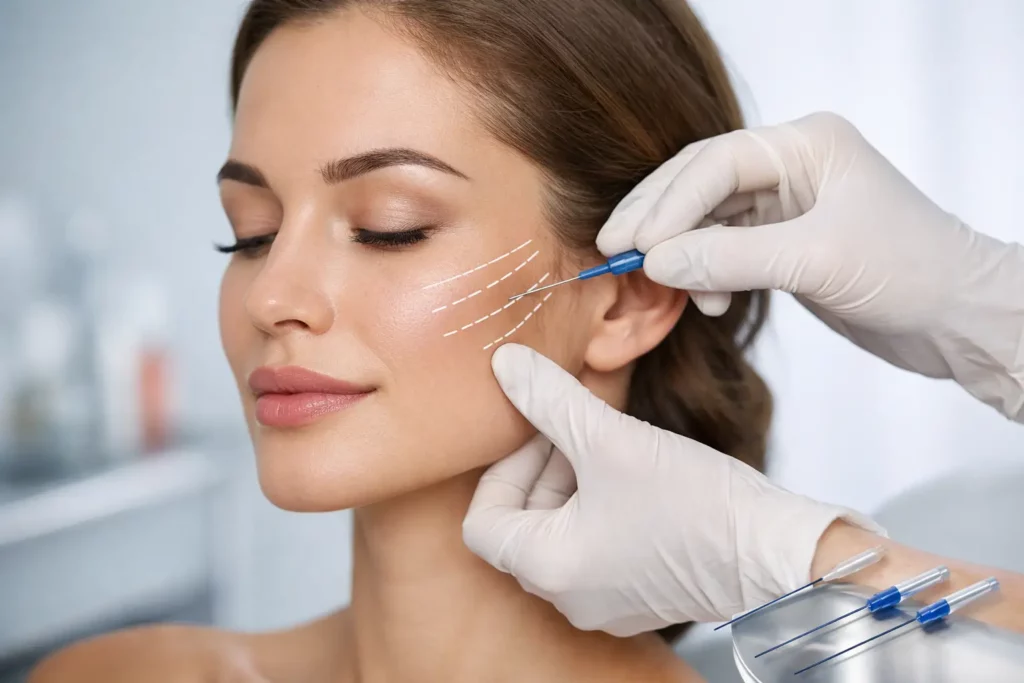
The treatment itself is typically done in the office. After the area is mapped and cleansed, a numbing agent is used to improve comfort. The threads are then inserted through a small entry point using a cannula or needle, depending on the plan and the area being treated.
Most appointments are fairly efficient, but they should never feel rushed. Good thread work requires planning, symmetry checks, and careful placement. You may feel pressure, movement, or a pulling sensation during treatment, but discomfort is usually manageable.
After the threads are placed, the provider adjusts the tissue to create the intended support. There can be some immediate visible lifting, though swelling can temporarily affect how the result looks in the first several days.
Recovery and downtime
Recovery is one of the reasons thread lifts appeal to busy adults. Most patients can return to many normal activities fairly quickly, but there are short-term restrictions that matter.
Swelling, tenderness, bruising, and a tight or slightly uneven feeling are common early on. Some patients also notice dimpling or puckering at first, especially in areas where tissue has been repositioned. This often improves as the tissue settles. Sleeping on your back, limiting exaggerated facial movement, avoiding strenuous exercise for a period, and following aftercare instructions closely can help protect the result.
Social downtime varies. Some people feel comfortable being seen within a few days, especially with minor bruising covered. Others prefer a week or two before events. If you have an important wedding, reunion, photoshoot, or work function, planning ahead is smart.
How long do PDO thread lift results last?
This is one of the most common questions, and the honest answer is that it depends. The threads themselves dissolve over time, but the collagen response and support they create can extend the benefit beyond the life of the thread.
Many patients enjoy visible improvement for around 9 to 18 months, though this range can vary based on thread type, treatment area, skin quality, age, movement, and lifestyle factors. Heavier tissue and stronger gravitational pull may shorten longevity. Good skincare, maintenance treatments, and a smart overall treatment plan can help preserve the refreshed look.
A thread lift also tends to age with you rather than freeze you in time. That is appealing to many patients who want to look better, not different.
Risks, side effects, and why expertise matters
PDO threads are minimally invasive, but they are still medical procedures. That means provider training and judgment are not optional extras. They are central to safety.
Common short-term side effects include swelling, bruising, soreness, asymmetry during early healing, and temporary skin irregularity. Less common but more significant risks can include infection, thread visibility, migration, contour irregularity, prolonged puckering, or an unsatisfactory cosmetic result.
The biggest protection is thoughtful patient selection and precise technique. A skilled provider knows when threads are appropriate, when they are not, and how to avoid overpromising. In a consultation-driven practice such as DermAlign Medical Aesthetics, that level of personalization is not a luxury. It is part of responsible care.
PDO threads versus filler, surgery, and collagen treatments
When patients compare options, the real question is usually not “Which is best?” but “Which is best for my face right now?”
Filler replaces volume. Threads reposition tissue. Neuromodulators relax muscle movement. Biostimulators such as Sculptra help improve collagen support over time. Surgery addresses more advanced laxity and structural aging. These treatments do not all compete with one another. Very often, they complement one another.
For example, someone with hollow cheeks and mild descent may not get the best result from threads alone. Someone with significant neck laxity may be happier with surgery than repeated non-surgical maintenance. Someone with early softening and good skin elasticity may love the subtle refresh that threads can provide.
That is why the best aesthetic plans are customized, not copied.
Questions to ask before you book
If you are considering threads, ask what kind of threads are being used, what result is realistic for your anatomy, how much downtime to expect, and what the full treatment plan may involve. Ask how often your provider performs thread lifts and whether your goals would be better served by a different option.
You should also ask to see before-and-after photos that reflect natural results, not exaggerated tension. A polished result should look like you on a better-rested, more defined day.
A good consultation should leave you feeling educated, not pressured. If the plan is right, thread lifts can be an elegant option for lifting and collagen support without surgery. If the plan is not right, the most trustworthy answer is sometimes no – or not yet.
The best next step is not chasing the fastest fix. It is choosing a treatment strategy that respects your anatomy, your timeline, and the version of you that still feels like you.