Skip to content
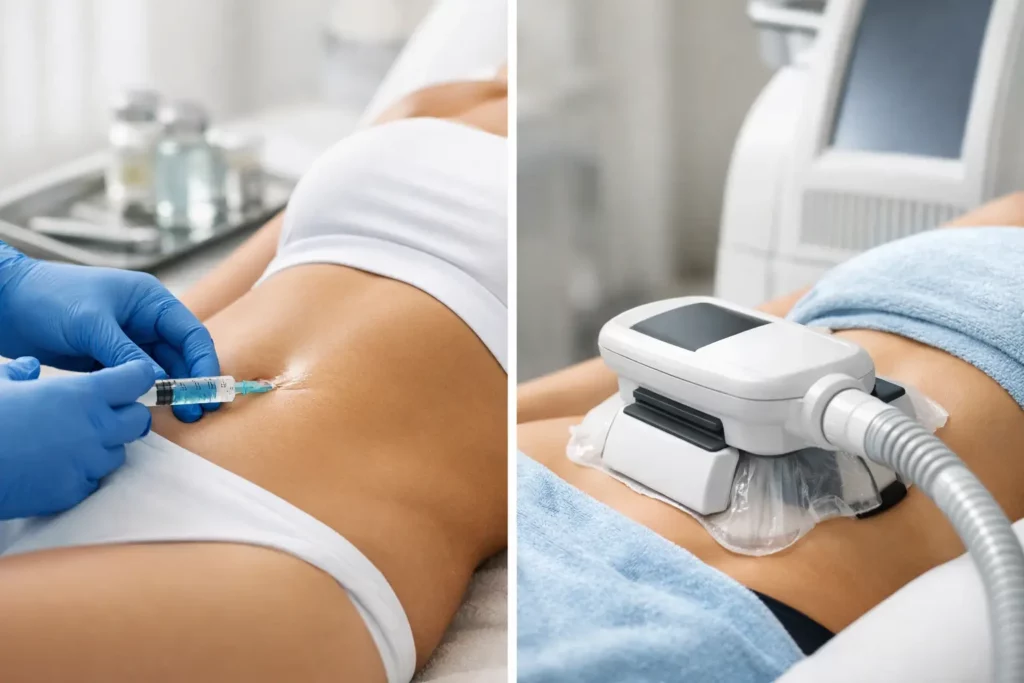
When a healthy lifestyle still leaves you with a small pocket of stubborn fat under the chin, along the bra line, or near the lower abdomen, the question usually is not whether you want treatment. It is which treatment makes more sense. For many patients, the real comparison is liquid lipo via pcdc vs. cool sculpting – two non-surgical approaches designed for fat reduction, but with very different treatment experiences.
Table of Contents
ToggleThe best option depends on your anatomy, your goals, your tolerance for downtime, and how precise you want the treatment to be. One is an injectable approach that targets localized fat with clinical precision. The other uses controlled cooling to reduce fat in a broader treatment area. Both can be effective in the right candidate. Neither is a substitute for weight loss, and neither should be chosen based on marketing alone.
Liquid lipo via PCDC vs. cool sculpting: what is the difference?
Liquid lipo via PCDC is an injectable fat-dissolving treatment used to address small, localized areas of stubborn fat. It is often selected for spots where precision matters, especially when contouring is part of the goal. The treatment works by introducing a solution into the targeted area, where it helps break down fat cells so the body can gradually clear them over time.
Cool sculpting, by contrast, uses controlled cooling applied externally through an applicator. The goal is to freeze fat cells beneath the skin without surgery. Over the following weeks and months, the body processes those damaged fat cells naturally.
That means the first major difference is delivery. PCDC is injected directly into the area being treated. Cool sculpting is applied from the outside using a device. The second difference is control. Injectable treatment can be highly tailored to smaller or more specific contour concerns, while cooling-based treatment often works best on pinchable fat in areas that fit the applicator well.
How each treatment fits different body concerns
If your concern is a very specific pocket of fat, PCDC often enters the conversation quickly. Patients commonly ask about it for the submental area under the chin, as well as other small contour issues where a more exact treatment plan matters. Because the product is placed directly into the target area, the provider has more control over shaping and customization.
Cool sculpting tends to be considered for broader areas of pinchable fat, such as the abdomen, flanks, thighs, or upper arms, assuming the tissue is suitable for the applicator. It can be appealing to patients who prefer a non-injectable option and want a treatment session that does not involve needles.
This is where consultation matters. Two people can have what looks like the same concern and still be better suited for different treatments. One may have firm, localized fullness that responds well to a targeted injectable plan. Another may have a wider area of soft, pinchable fat that is easier to treat with a cooling device. Good treatment planning starts with the tissue, not the trend.
Comfort and downtime are not the same thing
Many patients assume the treatment with no needles must be easier overall. That is not always true.
With PCDC, the injection process is brief, but swelling is common afterward, especially in areas like under the chin. That swelling can last for days and sometimes longer depending on the area treated and the individual response. Tenderness, firmness, and temporary bruising are also possible. The trade-off is that the treatment can be very precise.
With cool sculpting, the treatment itself often involves strong cold, pulling, pressure, and numbness during the session. Afterward, patients may experience soreness, tingling, sensitivity, or temporary numbness. There is usually less visible swelling than with injectable fat-dissolving treatments, but the treated area can still feel uncomfortable for a period of time.
So the better question is not which has downtime and which does not. It is what kind of downtime you are willing to accept. If visible swelling would bother you, that matters. If you would rather avoid injections but are fine with a longer in-office session and post-treatment numbness, that matters too.
Results timeline and how much patience you need
Neither treatment is instant. That can be frustrating for patients who are used to seeing quicker aesthetic changes with wrinkle relaxers or fillers.
PCDC results develop gradually as the body clears disrupted fat cells. Multiple sessions are often needed, depending on the area and the amount of fullness being treated. Some patients begin noticing contour improvement within weeks, but best results usually require a treatment series and time.
Cool sculpting also works slowly. The body needs time to process the treated fat cells after exposure to controlled cooling. Visible changes may start to appear within several weeks, with continued improvement over a few months. Some patients need more than one cycle or more than one treatment session to reach their desired outcome.
If you want a subtle, progressive change and you understand that body contouring is a process, both options can fit. If you are hoping for dramatic fat reduction after one visit, you may need a more realistic conversation about what non-surgical treatment can and cannot do.
Liquid lipo via PCDC vs. cool sculpting for under the chin
This is one of the most common comparison points because the under-chin area can be difficult to change with diet and exercise alone.
PCDC is often attractive here because the treatment is precise. When the goal is to refine the profile rather than simply reduce volume, precision matters. A skilled injector can map the area carefully and build a treatment plan around the patient’s anatomy, fullness, and skin quality.
Cool sculpting can also be used for submental fat in some cases, but the anatomy has to suit the applicator and the treatment plan. Not every under-chin concern is the same. Some patients have true submental fat. Others have skin laxity, platysmal banding, or structural anatomy that makes the area look fuller than it really is. In those cases, fat reduction alone may not create the improvement the patient expects.
That is why an experienced evaluation is so important. Treating the wrong issue with the right device is still the wrong treatment.
Safety, candidacy, and why screening matters
Both treatments should begin with a proper medical consultation. That is especially important in aesthetic medicine, where patients may be good candidates for one service but poor candidates for another.
PCDC is not ideal for everyone. Medical history, treatment area, skin quality, degree of fullness, and tolerance for swelling all matter. Cool sculpting also requires careful screening. The area has to be suitable for the applicator, and certain medical conditions can rule it out.
Skin elasticity matters more than many patients realize. If loose skin is the main issue, fat reduction can sometimes make the area look less full but not necessarily tighter. The result may be underwhelming if the treatment plan does not address the skin itself. That is one reason personalized care matters so much. A strong plan does not start with the device. It starts with the diagnosis.
Which treatment is better?
Better for whom is the real question.
PCDC may be the stronger choice if you want a more targeted approach, especially for smaller areas where contour precision is important. It can be an excellent fit for patients who are comfortable with injections and understand that swelling is part of the process.
Cool sculpting may be the better fit if you want a non-injectable treatment for a broader area of pinchable fat and you are comfortable with a device-based session and a slower visible change. For some patients, that feels like an easier entry point into body contouring.
There is also a practical consideration many people overlook: not every treatment works equally well on every body area. A method that performs beautifully under the chin may not be your best option for the flank, and vice versa. The best outcomes usually come from matching the treatment to the anatomy rather than trying to force one modality to solve every concern.
At a consultation-driven practice like DermAlign Medical Aesthetics, that conversation should feel clear and personalized. You should understand why a treatment is recommended, what the recovery looks like, how many sessions may be needed, and what kind of result is realistic for your body.
Price matters too, but value is bigger than the number attached to a session. A less expensive treatment that is not well suited to your anatomy can cost more in the long run if it leads to disappointment or additional corrective care.
If you are weighing liquid lipo via pcdc vs. cool sculpting, the smartest next step is not guessing which one is more popular. It is getting an honest assessment of what is actually causing the fullness you want to treat and choosing the option that fits your goals with precision, safety, and a plan you feel confident about.