Hair thinning in women rarely feels minor. It shows up in the shower drain, in photos, under bright bathroom lighting, and in the way a once-easy hairstyle suddenly takes more effort. For many patients, prp hair restoration women ask about is not really about vanity – it is about wanting to feel like themselves again in a way that looks natural, private, and medically grounded.
Why hair loss in women needs a different conversation
Female hair thinning is often more complex than people expect. Men may notice a receding hairline or balding at the crown, while women more often see diffuse thinning, widening of the part, reduced density at the temples, or an overall loss of volume. Hormones, stress, postpartum changes, genetics, thyroid issues, nutritional deficiencies, medication shifts, and age can all play a role.
That matters because treatment should never be one-size-fits-all. A woman in her 30s with postpartum shedding may need a very different plan than a woman in her 50s dealing with hormonal change and long-term pattern thinning. The best outcomes start with a careful consultation, not a rushed recommendation.
What PRP hair restoration for women actually is
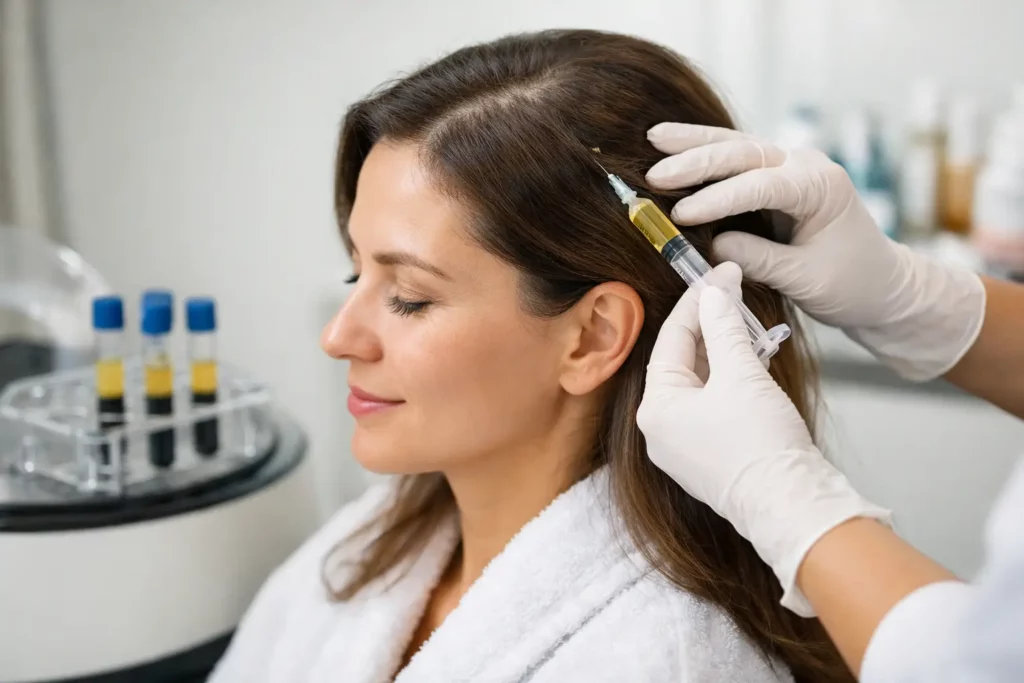
PRP stands for platelet-rich plasma. The treatment uses a small sample of your own blood, which is processed to concentrate the platelets and growth factors. That plasma is then injected into targeted areas of the scalp where hair is thinning.
The goal is to support the health of the hair follicle and improve the environment around it. In the right candidate, PRP can help encourage stronger, healthier growth and reduce ongoing shedding. It is not a hair transplant, and it does not create brand-new follicles where none remain. Instead, it works best when there are weakened or miniaturized follicles that still have the potential to respond.
This is one reason a medical assessment matters. If hair follicles are no longer active in a given area, PRP may have limited benefit there. If the follicles are still viable, treatment can be much more promising.
Who is a good candidate for PRP hair restoration women consider
PRP tends to be a strong option for women in the earlier to moderate stages of hair thinning. Patients often seek it out when they notice more scalp visibility, a wider part, less fullness in a ponytail, or increased shedding that has not fully improved.
It may be especially appealing if you want a non-surgical treatment that uses your own biologic material and fits into a broader plan for scalp and hair health. Women who still have existing hair in the treatment area usually respond better than those with long-standing, advanced loss.
There are also times when PRP should be approached carefully or postponed. If hair loss is being driven by an untreated medical issue, severe iron deficiency, active scalp inflammation, or certain systemic conditions, those factors need attention first. A transparent provider will tell you when PRP makes sense and when another path should come first.
What to expect during treatment
The appointment is typically straightforward. A small blood sample is drawn first. That sample is processed so the platelet-rich plasma can be separated and prepared for treatment. Once the scalp is cleansed and the areas of concern are mapped out, the PRP is injected into the scalp using a series of small injections.
Most patients describe the treatment as tolerable. The scalp is sensitive, so you may feel brief pressure or stinging in certain spots, especially near the front hairline or crown. The actual injection portion is usually relatively quick.
Afterward, mild tenderness, tightness, or scalp sensitivity can happen for a day or two. Some patients notice pinpoint redness that fades quickly. Because PRP is made from your own blood, the treatment is generally well tolerated, but technique, sterile handling, and appropriate candidate selection still matter.
How many PRP sessions are usually needed
One treatment is rarely the whole plan. Most women need an initial series followed by maintenance sessions. The exact timing depends on your degree of thinning, how long it has been happening, and whether PRP is being paired with other therapies.
A common approach is a set of early treatments spaced several weeks apart, followed by maintenance every few months. That schedule is not arbitrary. Hair grows in cycles, and stimulation takes time. A thoughtful provider will set realistic expectations rather than promise dramatic overnight change.
When results show up and what they look like
PRP works gradually. Most women do not look in the mirror two weeks later and see a dramatic difference. Early improvements often show up as reduced shedding, followed by better texture, improved density, and more visible fullness over time.
Some patients notice that their hair becomes easier to style before they notice obvious regrowth. Others see the part line soften or the crown look less sparse in bright light. These are meaningful changes, even if they are subtle at first.
It also helps to be honest about limits. PRP can support hair restoration, but it does not usually deliver the kind of dense transformation people associate with surgical transplants. For many women, the goal is improvement, stabilization, and healthier-looking hair rather than a complete reset to teenage density.
PRP hair restoration women often compare to other options
Women considering PRP are usually weighing more than one solution. Topical treatments can be useful, but not everyone loves the commitment, scalp residue, or irritation potential. Oral medications may help in some cases, but they are not right for every patient and may raise questions around side effects or long-term use. Hair extensions can camouflage thinning, but they may also add tension to already fragile hair.
PRP sits in a different category. It is procedure-based, non-surgical, and designed to biologically support the follicles you still have. For some women, it works best alone. For others, it makes more sense as part of a layered plan that may include scalp care, medical evaluation, nutritional support, or other hair growth therapies.
That is where customization matters. The right answer is not always the most aggressive one. It is the plan that matches your pattern of loss, comfort level, goals, and budget.
Why provider skill matters more than many patients realize
PRP sounds simple, but outcomes are shaped by more than the fact that plasma is being injected. The preparation process, treatment depth, placement, scalp assessment, and overall treatment strategy all make a difference. So does the ability to tell whether you are actually a candidate.
In a consultation-driven setting like DermAlign Medical Aesthetics, that conversation should feel clear and pressure-free. You should understand what PRP can do, what it cannot do, how many sessions may be recommended, and whether maintenance is part of the plan. Transparent guidance builds trust and usually leads to better long-term decisions.
Questions women should ask before starting
If you are considering PRP, ask what may be causing your hair thinning and whether any medical workup is recommended. Ask how many sessions are likely needed, how progress is evaluated, and what type of maintenance may be required. It is also fair to ask what happens if your response is modest rather than dramatic.
Good aesthetic medicine is never about selling a treatment in isolation. It is about matching the treatment to the person in front of you. Hair restoration is especially personal, and patients deserve a plan that reflects that.
The emotional side of treating hair loss
For many women, thinning hair affects confidence in ways other people do not always see. It can change how you wear your hair, how comfortable you feel in social settings, and even how polished you feel at work. Because the change is often gradual, it can also be easy to second-guess whether it is “bad enough” to address.
If you are thinking about treatment, you do not need to wait until thinning feels severe. Earlier intervention is often more effective than trying to reverse years of progression. And choosing treatment does not mean choosing something artificial. For many women, PRP feels appealing precisely because the results are meant to look like you – just healthier, fuller, and more supported over time.
The best next step is not chasing a trend or comparing your hair to someone else’s. It is getting a personalized assessment, asking smart questions, and choosing a plan that respects both your goals and your biology. When treatment is done thoughtfully, hair restoration can feel less like a cosmetic fix and more like a return to confidence on your own terms.